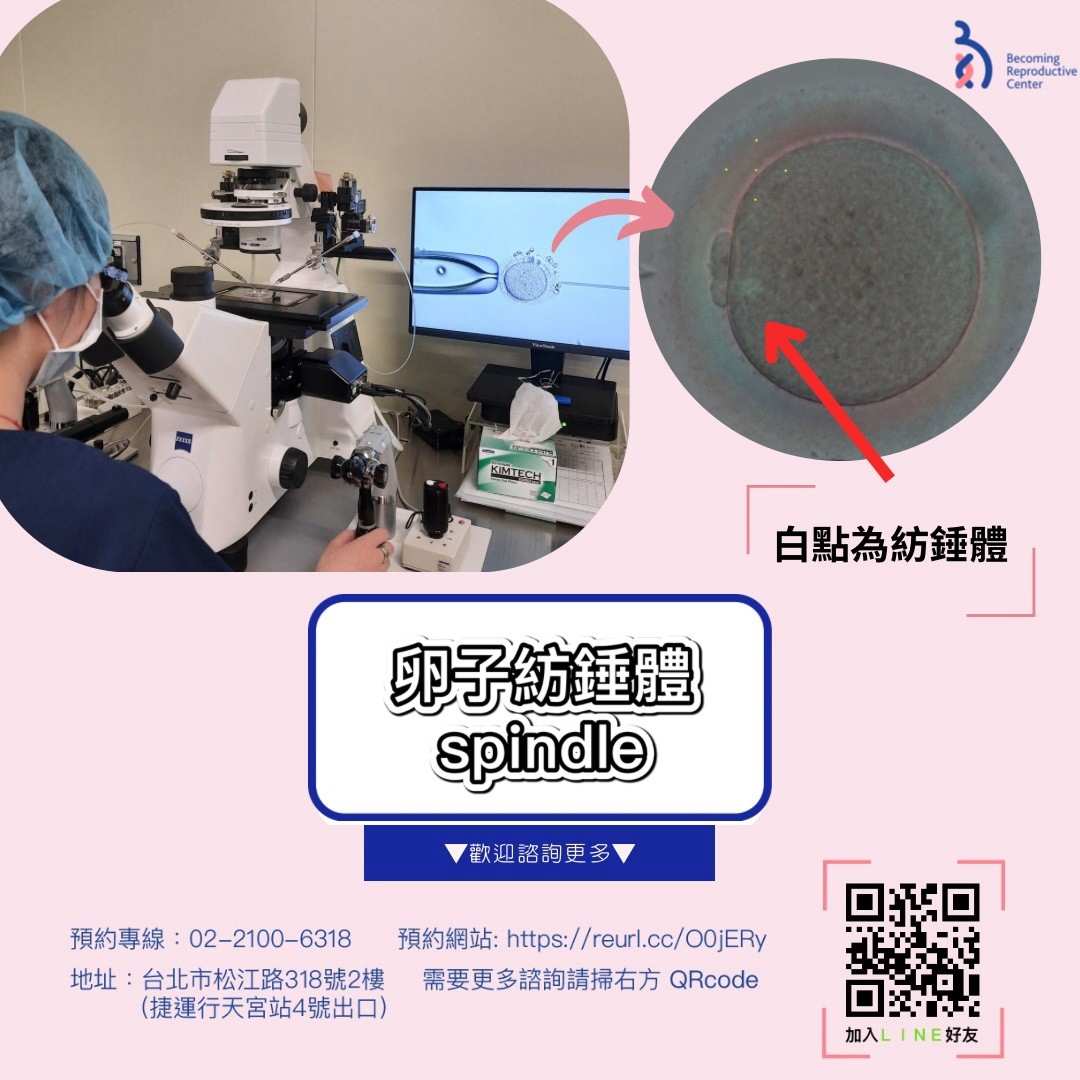
BRC embryologist Ying-Chieh Chen explains the oocyte spindle, starting from how the egg is formed. In the embryonic stage, oogonia begin mitosis to form primary oocytes; the primary oocytes start meiosis before birth and, from ages 0–12, remain in meiotic arrest (also called the prophase of the first meiotic division). Only when a girl has her first period is the first meiotic division completed, forming a secondary oocyte and the first polar body.
The secondary oocyte retrieved during egg collection is cultured in the BRC lab for 2–3 hours. During this time the egg completes the second meiotic division on its own and pauses at metaphase II — this is when the spindle appears, and only after it appears can intracytoplasmic sperm injection (ICSI) be performed. So around the 3rd hour, the embryologist uses a special spindle-viewing lens to check whether the spindle has appeared; if not, they wait another half hour and look again. The spindle is the soul organelle of cell division — a bit like the egg cell's mentor — gathering and lining up the chromosomes and dividing them into groups, making sure both groups have the same number of chromosomes.
Some eggs, due to aging plus freezing, thawing, oxidative stress and post-translational defects, have a spindle that fails to appear or becomes displaced. So if the spindle isn't checked before ICSI and the injection needle happens to pierce it, it's like striking the mentor — the chromosomes can't be lined up and grouped properly, and the cell struggles to divide and develop normally. This is why some IVF mothers wonder why their embryos fertilize abnormally or fail to develop — very likely the spindle "mentor" was injured!
The embryologist can use the spindle-viewing lens to rescue a displaced spindle; if the spindle can't be seen for the reasons above, they must rely on experience to judge its approximate position before injecting. In any batch of retrieved eggs, a few will have a displaced or invisible spindle, so our embryologists recommend using the spindle lens to observe these precious eggs — giving displaced spindles a chance to develop into beautiful embryos too.
BRC ㊗️ wishes your dreams come true!