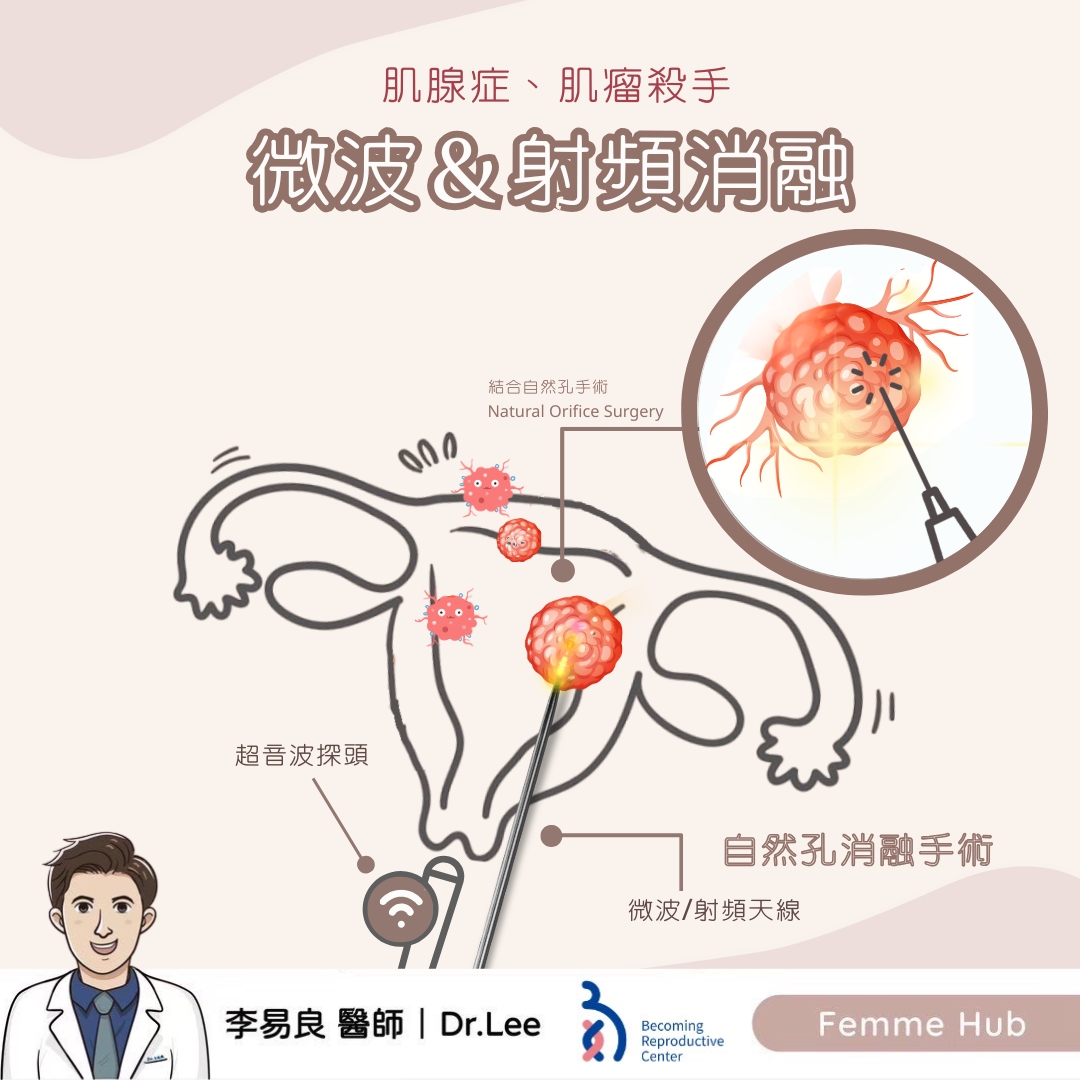
The Killer of Adenomyosis and Uterine Fibroids
Natural Orifice Ablation Surgery: Microwave Ablation & Radiofrequency Ablation
In recent years, energy ablation techniques, mainly microwave and radiofrequency ablation, have gradually been applied in the treatment of uterine fibroids and adenomyosis.
Under image guidance, a fine needle is inserted directly into the lesion. Energy is then used to heat the tissue, causing tumor cells to undergo necrosis and gradually shrink.
・When combined with Natural Orifice Surgery, entering through the vagina without leaving any abdominal incision, this becomes natural orifice ablation surgery.
・This approach combines uterine preservation with a scarless result, greatly reducing wound pain and the risk of infection.
・Clinical features
・Microwave Ablation, MWA
MWA heats quickly and creates a larger ablation area. The average procedure time is relatively shorter, and it works well for medium to large lesions.
・Radiofrequency Ablation, RFA
RFA heats more slowly but allows precise control. It is especially suitable for smaller lesions or deeper lesions, although the average procedure time is longer.
・In my clinical experience, the advantages of these ablation procedures are smaller wounds and faster recovery.
・Especially when performed through a natural orifice or single-port laparoscopic approach, they can almost achieve a “scarless appearance.”
・Indications
・Small to medium-sized uterine fibroids, especially those associated with heavy menstrual bleeding or anemia
・Adenomyosis causing menstrual pain or heavy menstrual bleeding
・Women who wish to avoid hysterectomy and still have fertility needs
・Patients with poor response to medication, such as painkillers, hormones, or intrauterine devices
・Limitations and points to note
Compared with complete surgical removal, ablation has some limitations:
- 1.Slower symptom improvement
The tumor needs time to shrink, so improvement in menstrual bleeding and pressure symptoms may take several weeks to several months.
- 1.
Limited effect for large lesions
- 2.
For fibroids larger than 7 cm, the degree of shrinkage and symptom improvement may not be as good as surgical removal.
- 3.
Dependence on hormonal treatment
- 4.
Some hospitals combine ablation with hormonal therapy to enhance the effect. However, I prefer to avoid long-term hormone use to reduce risks such as breast cancer and thrombosis.
- 5.
Limitation in number of lesions
- 6.
Ablation usually targets one lesion at a time. For multiple fibroids, the treatment range is limited, which may be less advantageous compared with HIFU.
- 7.
Anatomical conditions
- 8.
If the uterus is too large, the lesions are widely distributed, or there are severe adhesions, this procedure may not be suitable.
- 9.
Clinical advantages
- 10.
Truly scarless
The procedure is performed completely through the vagina, without abdominal incisions.
- 1.
Faster recovery
- 2.
Patients can often get out of bed the next day, and hospitalization time is shorter.
- 3.
Uterus preservation
- 4.
Suitable for patients who wish to preserve fertility and meet psychological needs.
- 5.
Symptom improvement
- 6.
Studies show that after natural orifice ablation, more than 70% of patients experience significant improvement in menstrual bleeding and pain.
- 7.
BRCIVF wishes your dreams come true!