Recurrent Miscarriage Causes Physical and Emotional Distress; PGS Effectively Improves Pregnancy Success Rates Health Medical Network / Reported by Yi-Ting Lin Published on August 16, 2018
A 37-year-old woman, Ms. Chia, had been married for 8 years. She and her husband had a strong and stable relationship, and her career had also been going smoothly.
During the first 5 years of marriage, she and her husband agreed to focus their efforts on their careers. It was not until she turned 35 that they began thinking about having a child. However, after trying to conceive naturally for nearly a year, they still did not receive the good news they had been waiting for.
Later, she visited an obstetrics and gynecology clinic and attempted IVF treatment. Unfortunately, after embryo transfer, she experienced repeated miscarriages for unknown reasons. This caused not only physical discomfort, but also deep emotional suffering.
Through a friend’s referral, Ms. Chia and her husband visited Taipei Zhongshan Reproductive Medicine Center. After both underwent examinations, her husband was diagnosed with balanced chromosomal translocation, which can easily lead to chromosomal abnormalities in embryos and result in miscarriage.
Therefore, the physician recommended Preimplantation Genetic Screening, PGS, to select chromosomally normal embryos for transfer. She successfully conceived and, after 10 months of pregnancy, gave birth to a healthy baby, fulfilling the couple’s dream of becoming parents.
Preimplantation Genetic Screening can significantly reduce the possibility of miscarriage
Dr. Hui-Po Li, Director of the Reproductive Medicine Center at Taipei Zhongshan Hospital, stated that when patients with infertility undergo IVF multiple times but experience recurrent miscarriage after embryo transfer, the two most common causes are chromosomal abnormalities in embryos or an unfavorable endometrial implantation environment.
If the cause is embryo chromosomal abnormality, PGS may be considered. A small number of cells are biopsied from embryos that have developed to the blastocyst stage on day 5 after fertilization. These cells are analyzed to determine whether the embryo chromosomes are normal before the embryo is transferred into the uterus.
This can not only improve the implantation success rate, but also greatly reduce the chance of miscarriage caused by chromosomal abnormalities.
Professional evaluation before treatment: PGS brings new hope to patients with infertility
According to international literature, Mol Cytogenet. 2012 2;5(1):24, embryo screening can effectively improve IVF pregnancy rates, benefit many patients with infertility, and reduce the number of treatment cycles.
However, the latest presentation at the 2018 annual meeting of the European Society of Human Reproduction and Embryology, ESHRE, showed that PGS may reduce implantation rates by 20% to 40%.
The main reason is that, during the screening process, intracytoplasmic sperm injection, ICSI, must be performed. After the embryo develops into a blastocyst, a biopsy must also be taken from the part of the embryo that will later form the placenta. This may increase the possibility of damage to the embryo.
Therefore, Dr. Li pointed out that even if a tested normal embryo is transferred, it does not guarantee that the embryo will implant successfully or result in pregnancy.
Before undergoing PGS, couples should still visit an infertility specialist for detailed consultation and examination to evaluate whether screening is necessary.
For patients of advanced maternal age, those who have had two or more miscarriages, those with repeated IVF failures, or those with a family history of chromosomal abnormalities, PGS may help improve pregnancy rates and reduce the time spent undergoing repeated treatments.
However, if the patient is over 40 years old and retrieves very few eggs in a single cycle, PGS is not recommended. This is to avoid lowering implantation rates due to possible embryo damage.
Regular prenatal checkups and chromosomal screening help confirm fetal health
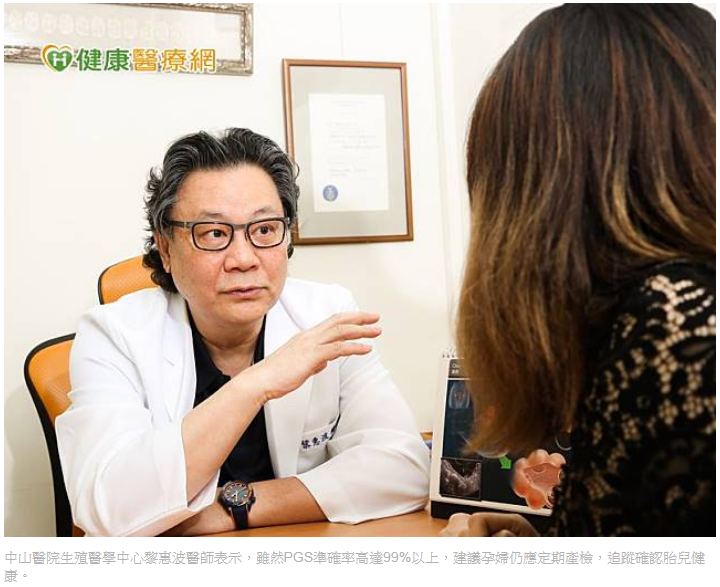
Dr. Hui-Po Li explained that the current accuracy rate of PGS is over 99%, but the technology still has limitations and cannot completely rule out the possibility of fetal chromosomal abnormalities.
Therefore, even after successful pregnancy through PGS testing, patients are still advised to receive regular prenatal checkups. Tests such as non-invasive prenatal chromosomal screening, chorionic villus sampling, or amniocentesis may also be performed to continuously monitor and protect the baby’s health.